Why Kitchen Knife Handles Crack G10 vs Wood Water Absorption Rates
A cracked knife handle rarely starts as a dramatic failure. It usually begins as a tiny gap near a pin, a faint lift along the tang, or a hairline split after repeated washing. By the time a customer notices it, the product may already be headed back as a return.
For kitchen knives, the handle is not just a comfort part. It affects hygiene, durability, perceived quality, and compliance expectations in food service. The material choice matters, especially when handles face water, steam, detergent, sanitizer, and temperature swings every day.
The biggest reason many handles crack is simple: moisture moves differently through different materials. G10 and wood-based handles respond to water in very different ways, and that difference can decide whether a knife survives commercial use or fails after a few wash cycles.
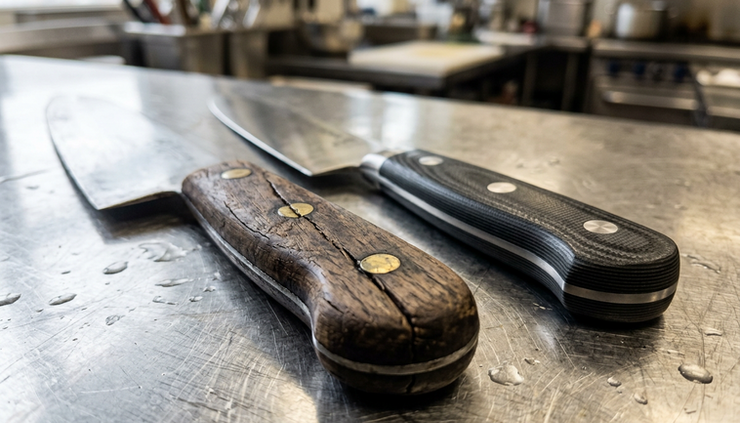
Why kitchen knife handles crack in the first place
Most handle cracks come from stress. Water is one source of that stress, but it is not the only one.
A knife handle goes through several repeated forces:
Wetting during prep and washing
Drying after storage or air exposure
Heat from dishwashers, steam, or hot sinks
Detergent and sanitizer contact
Expansion and contraction of handle scales
Pressure around pins, rivets, and the tang
Small gaps that trap water along the adhesive line
When a handle absorbs water, the material swells. When it dries, it shrinks. That movement may be tiny, but repeated cycles can break glue bonds, widen pin holes, and create visible cracks.
Wood is especially sensitive because it is a natural cellular material. It absorbs moisture through grain, pores, end grain, and exposed surfaces. Even stabilized or resin-treated wood can move if water reaches unfinished sections or manufacturing defects.
G10 behaves differently. It is a fiberglass cloth laminate bonded with epoxy resin. The structure is dense, stable, and highly resistant to water. It does not swell like wood, which makes it far less likely to crack from moisture cycling alone.
G10 has a low water absorption rate and stable shape
G10 is widely used in knife handles because it combines strength, grip, and water resistance. It is made by layering glass fabric with epoxy resin under heat and pressure. Once cured, the material becomes hard, dense, and dimensionally stable.
That stability is the main advantage.
In wet kitchen conditions, G10 does not act like natural wood. It does not have grain that pulls in moisture. It does not swell noticeably during normal washing. It does not shrink as it dries in the same way wood does.
This matters because kitchen knives often fail at the connection points. A stable handle scale puts less movement stress on:
Pins and rivets
Adhesive layers
Full tang edges
Bolster joints
Handle seams
For product teams comparing materials, Handle Stabilization is not only about making the handle feel solid on day one. It is about reducing movement after repeated water exposure.
G10 also supports food service use because it is nonporous compared with natural wood. A smooth, well-finished G10 handle is easier to clean and less likely to harbor residue in cracks or grain openings. For commercial suppliers focused on NSF-style expectations, that cleanability is a major practical advantage.
Wood absorbs water because it is built to move
Wood is attractive, warm, and traditional. Many buyers still prefer it because it looks premium. But wood is hygroscopic, which means it takes in and releases moisture from the surrounding environment.
That movement is normal. The problem is that knife handles are attached to metal tangs, pins, and adhesives that do not move the same way.
When a wood handle absorbs water, it can swell across the grain. When it dries, it can shrink. This creates a push-pull effect around rigid metal parts. Over time, the stress often appears as:
Cracks near pins
Raised scales along the tang
Separation at the bolster
Gaps between handle and metal
Rough grain after washing
Warping or twisting on thin scales
End grain is especially vulnerable. If the end of a wooden handle is poorly sealed, it can drink in water quickly. Small manufacturing flaws also matter. A tiny void under the scale can hold moisture and speed up adhesive failure.
Dishwashers make this worse. Heat, detergent, and rapid drying all punish wood. Even if a knife is labeled hand wash only, customers may still put it in a dishwasher. For Amazon FBA products, that real-world misuse often becomes a return reason, not a customer education problem.
Pakkawood improves wood, but it is not the same as G10
Pakkawood is a common compromise. It is made from thin layers of wood veneer impregnated with resin, then compressed. This gives it better stability than untreated wood and allows rich colors and patterns.
It is usually more water resistant than plain wood. It can also feel more premium than synthetic materials to some buyers. But it is still not identical to G10.
The key difference is structure. Pakkawood still contains wood fibers and laminated layers. If the resin penetration is uneven, if the edges are poorly sealed, or if sanding exposes absorbent areas, water can find its way in. Once water enters, the handle can swell, separate, or develop surface checking.
G10 is more uniform as an industrial laminate. It does not depend on natural grain, veneer quality, or wood fiber behavior. That gives it a durability edge in wet, high-volume kitchens.
Material | Water behavior | Typical cracking risk |
Untreated wood | Absorbs and releases moisture readily | Higher risk from swelling, shrinking, and grain splits |
Stabilized wood | More resistant than raw wood, quality varies | Moderate risk if sealing or resin penetration is uneven |
Pakkawood | Resin-treated veneer improves water resistance | Lower than plain wood, but exposed edges and layers can fail |
G10 | Very low absorption and strong dimensional stability | Low risk from moisture cycling under normal kitchen use |
For anyone tracking Water Absorption Rate, G10 vs Pakkawood, Cutlery Durability, Amazon Return Rates. the comparison should not stop at appearance. The real question is how the handle behaves after repeated wet-dry cycles.

Why water absorption becomes a return problem
A customer rarely writes, “The handle material had poor dimensional stability.” They write, “Handle cracked,” “Rivet came loose,” “Gap appeared,” or “Feels unsafe.”
Those complaints often come from moisture-related movement. In e-commerce, the customer does not care whether the problem came from dishwashing, storage, humidity, or a weak adhesive bond. The visible defect defines the product.
For Amazon FBA sellers, handle cracking can hurt in several ways:
More returns and refunds
Lower star ratings
Photos in negative reviews
More “defective item” claims
Less trust in the knife set
Higher inspection pressure on future inventory
The issue is even sharper for restaurant and food service suppliers. A cracked handle can become a hygiene concern. Gaps can trap food residue and moisture. Rough or split surfaces are harder to clean. In commercial kitchens, the handle must withstand repeated sanitation practices, not just occasional home use.
That is why NSF-minded buyers often prefer smooth, nonabsorbent, easy-to-clean handle materials. Certification requirements depend on the exact product and standard, but the general expectation is clear: food-contact and nearby surfaces should resist moisture, clean well, and avoid crevices where contamination can build.
Design and manufacturing matter as much as material choice
G10 is highly water resistant, but poor construction can still cause failures. Wood can perform better when it is properly selected, dried, stabilized, sealed, and assembled. Material choice sets the ceiling, but manufacturing controls the outcome.
The most common handle failure points include:
Pin holes
Oversized or poorly bonded pin holes can collect water. If the scale moves, cracks often start there.
Tang fit
A full tang handle needs tight contact between metal and scale. Gaps become capillary channels for water.
Adhesive coverage
Uneven adhesive leaves hidden voids. Water can sit in those voids and weaken the bond.
Edge finishing
Sharp handle edges, exposed end grain, and poorly sealed laminated layers raise failure risk.
Surface texture
A handle can have grip without deep grooves. Deep texture may trap residue if it is not designed for cleanability.
For G10, good machining and finishing matter. For Pakkawood or wood, sealing and edge protection matter even more. A premium-looking handle with weak sealing may perform worse than a plain synthetic handle in a commercial sink.
How to choose between G10 and wood for kitchen knives
The right material depends on the selling channel, buyer expectations, and use case.
Choose G10 when durability and low returns matter most. It is a strong fit for:
Commercial kitchen knives
Butcher and prep knives
NSF-oriented product lines
Dishwasher-risk environments
Amazon listings where buyers expect easy care
Knife sets sold to broad, non-specialist customers
Choose wood or Pakkawood when appearance and traditional feel matter more. These handles can work well for:
Premium gift knives
Hand-wash-only products
Boutique cutlery
Buyers who understand knife care
Product lines where visual warmth is a key selling point
The tradeoff is clear. Wood can look beautiful, but it asks for better care. G10 looks more technical, but it forgives wet use better.
For marketplace sellers, that difference affects product copy too. If a knife has a wood-based handle, care instructions must be clear and visible. If a knife has a G10 handle, the listing can confidently focus on water resistance, stability, and cleanability, as long as those claims match the actual product.
Testing handles before scaling inventory
A basic visual inspection is not enough. Handles should be tested under realistic conditions before bulk orders ship.
Useful checks include:
Repeated hand-wash and dry cycles
Warm water soaking for controlled periods
Detergent exposure
Sanitizer contact when relevant
Temperature cycling
Pin and rivet inspection after drying
Gap checks along the tang
Surface roughness checks after washing
The goal is not to abuse the knife beyond reason. The goal is to catch predictable failures before customers do.
For FBA inventory, this is especially important because defects scale quickly. A small cracking rate in a sample batch can become a costly return pattern when hundreds or thousands of units reach buyers.
The practical takeaway
Kitchen knife handles crack when the material moves, the construction allows water in, or repeated wet-dry cycles stress weak points. Wood and Pakkawood can be attractive and marketable, but they absorb and respond to moisture more than G10. That movement increases the risk of cracks, gaps, and loose fittings.
G10 offers a clear advantage for wet kitchen use because it has very low water absorption and strong dimensional stability. For commercial food service, NSF-minded supply, and Amazon products where returns can damage profit fast, that stability is more than a material detail. It is a product strategy.
If the knife must survive real sinks, real cooks, and real customer habits, choose the handle material that moves the least when water shows up.


Comments